Almost none
of it grew
here.
The market, 2024
Nearly 80% of the flowers sold here, by value, were grown somewhere else.1
Two countries and one airport.
In the six weeks before Valentine's Day 2024, US Customs cleared 1.1 billion cut flowers.4 I'm not asking anyone to stop buying any of it. I'm asking you to know what you're buying.
The farm count doesn't record what happened to any one of them. It records that there used to be more.
Roses fell hardest. The value of the American rose crop dropped from $122.5 million in 1997 to $67.7 million in 2001.5
And the scent went with them. That isn't nostalgia. Most modern cut-rose varieties have little fragrance at all. Centuries of breeding chose colour, form and vase life, and scent was what got traded away.8 A rose bred to survive a week in a box is not bred to be smelled. Put your face in one from a field and you'll know within a second which one you're holding.
It isn't only imports
A cut flower has almost no shelf life.
A dahlia is at its best for four days, then it's compost. Cut at the right hour, cooled within the hour, cold every hour after. Miss a link and the harvest isn't discounted, it's worthless.
The system built to solve that was built for freight: refrigerated aircraft, uniform boxes, standing weekly volume. The question for a small grower was never whether a distributor would take a hundred bunches. It's whether anyone will take ten. Or five. The quantity that decides a grower's month is too small to be worth a distributor's paperwork.
So growers build their own way to market, and most already have: markets, florists, weddings, a website, an account that has to be fed. It works. It's also a second job.
After a full day of farming, a second full-time job in sales isn't just exhausting. It's unrealistic.
Something has to give, and what gives is being found. They aren't on the shelf you're standing at. They aren't in the search result. And when you do find one, the farm might be thirty minutes away, or three hours.
Meanwhile the supermarket is always closer. Trader Joe's, the corner grocer, the big chain: every one of them puts cheap flowers by the door at the precise moment you're already there, buying wine and limes for Friday night. The bouquet is in your hand before you'd decided you wanted one. That is a formidable thing to compete with, and no flower farm can. It isn't only price. It's being in the right place at the only moment anyone was going to think about flowers.
Los Angeles is luckier than most. The flower market downtown opens to the public five mornings a week, and a California grower can stand in it alongside the importers and be picked on the merits.9 Most of the country has nothing like it.
The problem was never that people don't want local flowers. It's that nothing is built to hand them one.
And yet
3,347
American farms sold cut flowers in 2024, up 64% in five years.10 More farms, in more states, closer to more people than at any point in my lifetime.
The comeback is real. It is also one bad season deep.
The part you can do something about
Know what you're buying.
Go to the market
Once a week, once a month, whatever you'll actually keep. Look up the farm stands near you and go visit a few. Make it a Sunday.
Buy what's in season
This is the one nearly everyone can do. Buy flowers at the farmers market while it's running, and buy what's growing right now.
Find a subscription
A flower CSA, a farm box, a delivery route. It's the thing a grower can count on, and you stop having to think about it.
Get five friends together
Know five people who'd take farm-fresh flowers monthly? Pay someone to drive out and collect for all of you. I did exactly this. It works.
Then spread them around
Bring them to parties. Set up a bouquet bar. Flower bomb someone who isn't expecting it. Spread the love and keep it local at the same time.
Ask your grocer
If they buy local, you've found your source. If they don't, have them email info@poppyfielding.com and I'll find them one.
Vote with your dollar. For the little guy. For the local woman growing your flowers.
Build a movement.
Buy local flowers.
Poppy Fielding doesn't sell anything and doesn't take a cut. If you'd like to work with a grower listed here, contact them directly and tell them Poppy Fielding sent you. If you'd rather have an introduction, email info@poppyfielding.com.
— Kellie Hartwell
Los Angeles
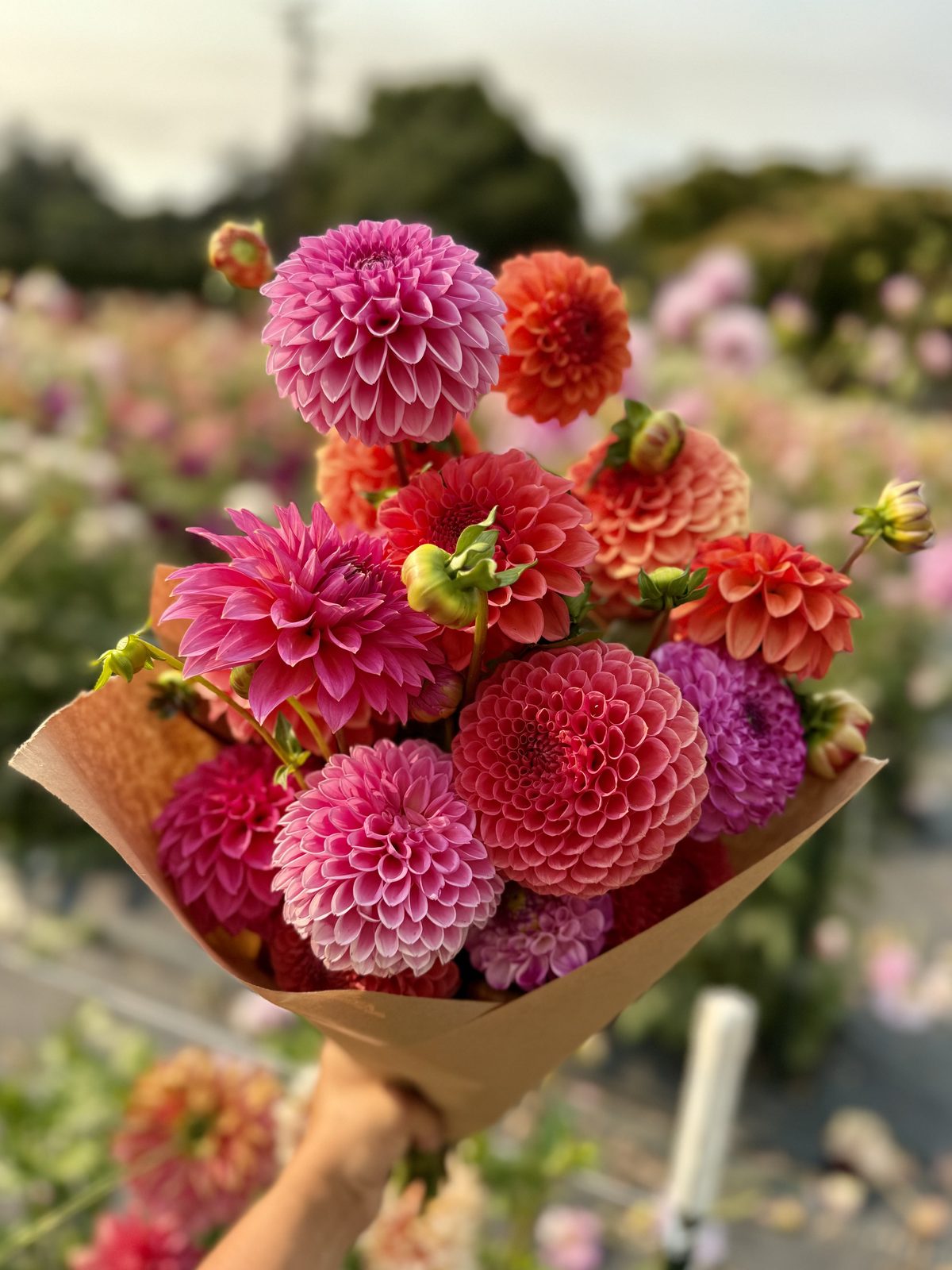
Rather Rooted · @rather_rooted One acre in Arroyo Grande, California. Seventeen hundred dahlias. She grows what she sells.12
Sources
Every figure on this page is sourced and dated, or it doesn't appear.
- farmdoc daily, University of Illinois, “Valentine's Day and the Gains from Agricultural Trade: Cut Flowers in the US,” February 2025. Data year 2024. Link
- USDA NASS, 2024 Floriculture Crops, Highlights No. 2026-1, February 2026. Domestic wholesale value; covers operations with $100,000+ in sales. Import value is customs value; the two are close but not identical measures. Link
- Miami-Dade Aviation Department, 9 February 2022 (91%); corroborated at ~89% by US Customs and Border Protection, 2017. Link
- US Customs and Border Protection, “CBP Tops 1B Cut Flower Imports for Valentine's Day,” 13 February 2024, covering 1 January – 13 February 2024. Link
- US International Trade Commission, “Cut Flowers,” Publication 3580, February 2003. Rose values cover 36 major producing states, growers with $100,000+ in sales. Link
- USDA NASS, 2024 Census of Horticultural Specialties, Table 13, released 26 February 2026. All rose types summed from published rows: $24.6 million. Link
- USDA Economic Research Service, Chart of Note, 9 May 2023: fresh-cut rose imports exceeded $800 million in FY2022. Domestic figure is 2024, the nearest years published. Link
- Shi, S. & Zhang, Z., “Genetic and Biochemical Aspects of Floral Scents in Roses,” International Journal of Molecular Sciences, 2022: “most modern cultivars used for cut flowers have little fragrance as a result of breeding preference for other traits, such as the flower color and form or longevity in roses.” Link
- The Original Los Angeles Flower Market, 754 Wall Street, downtown Los Angeles. Public hours Monday–Thursday 5am–12pm, Friday–Saturday 5am–2pm; closed Sunday. Thirty-five vendors, “many family owned and operated.” Link
- USDA NASS, 2024 Census of Horticultural Specialties, released 26 February 2026. Operations from Table 1 (2,035 in 2019; 3,347 in 2024); California from Chapter 2, Table 12. State shares computed from published USDA rows. Link
- Computed from the same census: $245,389,000 in sales across 2,982 operations outside California, 2024. A mean, not a median, and the census counts operations with $10,000 or more in sales, so the typical farm is smaller than the average shown.
- Rather Rooted Family Farm, Arroyo Grande, California: “our field of 1700 specialty dahlias… our one acre homestead.” Directory listing discloses: grows what they sell. ratherrooted.com
USDA publishes cut flower sales through three surveys with different thresholds. Figures here come from the Census of Horticultural Specialties except where the Floriculture Crops survey is named, and the two are never combined into a single trend.